Don't Just Study Science. Build It.
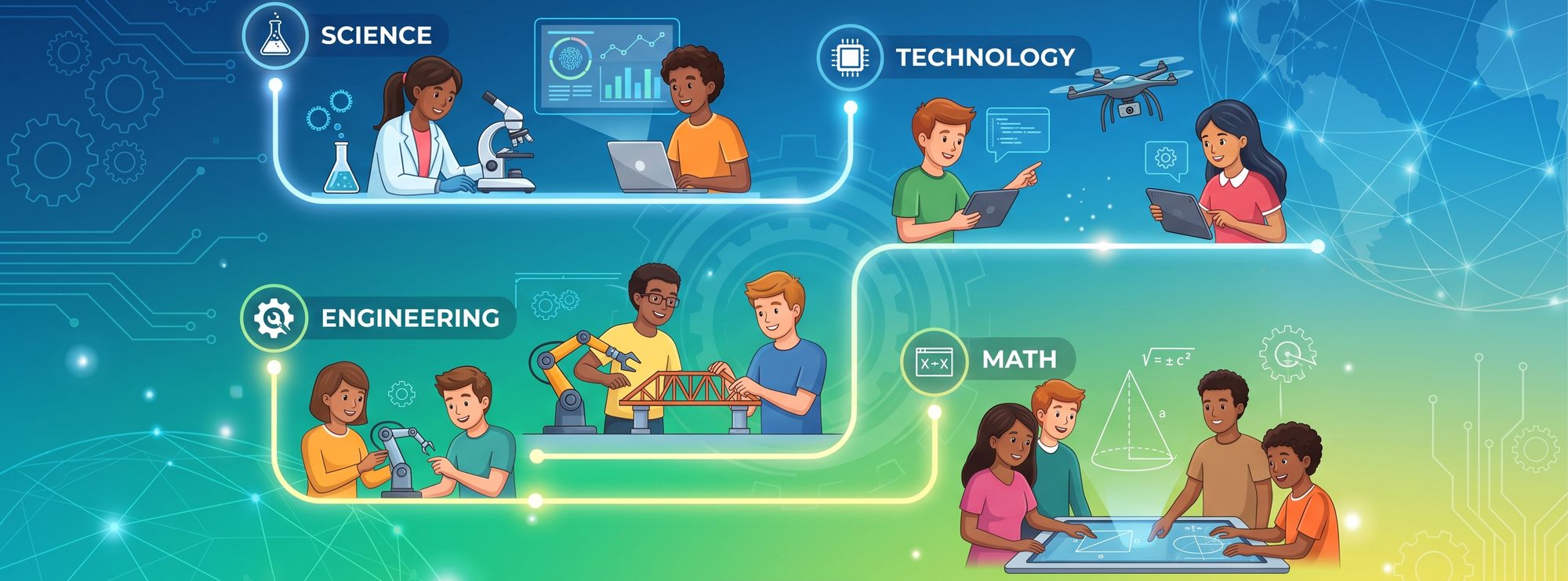
Every class in our hands-on STEM program for kids ends with something that actually works — a robot that moves, an LED circuit that lights up, a solar-powered car that drives on sunlight, or an Arduino project your child coded themselves. Designed for children ages 6 to 14, our STEM classes teach real robotics, real circuits, and real coding — hands-on science education, not worksheets or slide-only lectures.
What your child will build on day one.
No lectures, no theory-only sessions. In the very first class, your child closes their own circuit and watches a bulb they wired turn on.
Six real builds. Zero simulations.
Each project below is something your child assembles, wires, or codes themselves over the course — and takes home a photo of, working.
Child-Built Robot
From chassis to motors, your child assembles a rolling robot from raw parts — then codes its first movement.
LED Circuit, Wired Live
A breadboard, a battery, and a bulb — your child places every component and watches their own circuit light up.
Solar-Powered Car
A small chassis, a solar panel, and a motor — built and raced on nothing but sunlight from the classroom window.
Hydraulic Machine
Syringes, tubing, and water pressure — your child builds a working hydraulic arm that lifts and grips on its own force.
Obstacle-Avoiding Robot
A sensor-equipped robot your child programs to sense a wall or hand in its path — and steer around it on its own.
Arduino Traffic Light
Your child writes and uploads real code to an Arduino board, timing red, amber and green like an actual intersection.
Day 1 versus Demo Day.
The same child, roughly eight weeks apart. This is the gap we're building toward.
Hasn't held a screwdriver
- Doesn't know a resistor from a capacitor
- Nervous about "breaking" something
- Has only ever seen circuits in a textbook diagram
- Needs the teacher for every single step
Presents a working project to family
- Explains how their circuit or robot actually works
- Debugs a loose wire or a wrong line of code alone
- Has a portfolio of six finished, working builds
- Wants to build the next thing at home
The teacher explains by building, not by lecturing.
Demonstrate live, then step back
Every experiment is shown once, hands-on, before students touch their own kit — no video-only walkthroughs.
Small batches, high supervision
Limited seats per batch so every child gets hands-on time with tools and components, not just a turn to watch.
Debugging is part of the lesson
A circuit that doesn't light up first try isn't a failure — it's the moment your child learns to troubleshoot.
Every build goes home
Robots, circuits and cars are documented and, where possible, sent home — proof of what your child made.
What parents notice first.
"He came home and rebuilt the LED circuit with spare parts from a drawer, just to show us. I didn't expect that reaction from a first class."
Parent of a 9-year-old, Batch: Weekday Evenings
"On demo day she explained her obstacle robot's sensors better than I could follow. That's when it hit me she actually understood it, not memorized it."
Parent of an 11-year-old, Batch: Saturday Morning
"The solar car now sits on his windowsill charging every afternoon. It's not a school project anymore, it's just his thing."
Parent of a 10-year-old, Batch: Weekend Batch
Reserve your child's seat.
Seats are limited per batch to keep hands-on time high. Fill in the form and we'll call to confirm the batch and schedule.